

AI & intelligent services
Agents that do the work, with a human where it matters.
We design, build and run AI agents that carry multi-step work across your systems — retrieving, reasoning, calling tools and taking action — inside guardrails, evaluation and the approval gates your operation requires.
Agent design · Multi-agent orchestration · Tool integration · Guardrails · Human oversight
01 — What an agent actually is
An agent is not a chatbot.
It is a worker with tools.
A chatbot answers. An agent plans a sequence of steps, calls the systems it needs, checks its own work against the rules you set, and either completes the task or hands it to a person with everything required to decide.
That is only safe when the boundaries are explicit: which tools it may call, what it may change without approval, what it must escalate, and how every action is recorded.
We build agents inside those boundaries from the first sprint, using ZeaIQ for orchestration, identity, guardrails and audit — which is what keeps the distance short between a prototype that works and something your operations team will accept.
Talk to Zealogics02 — Anatomy of an agent
Plan, retrieve, act, check, escalate.
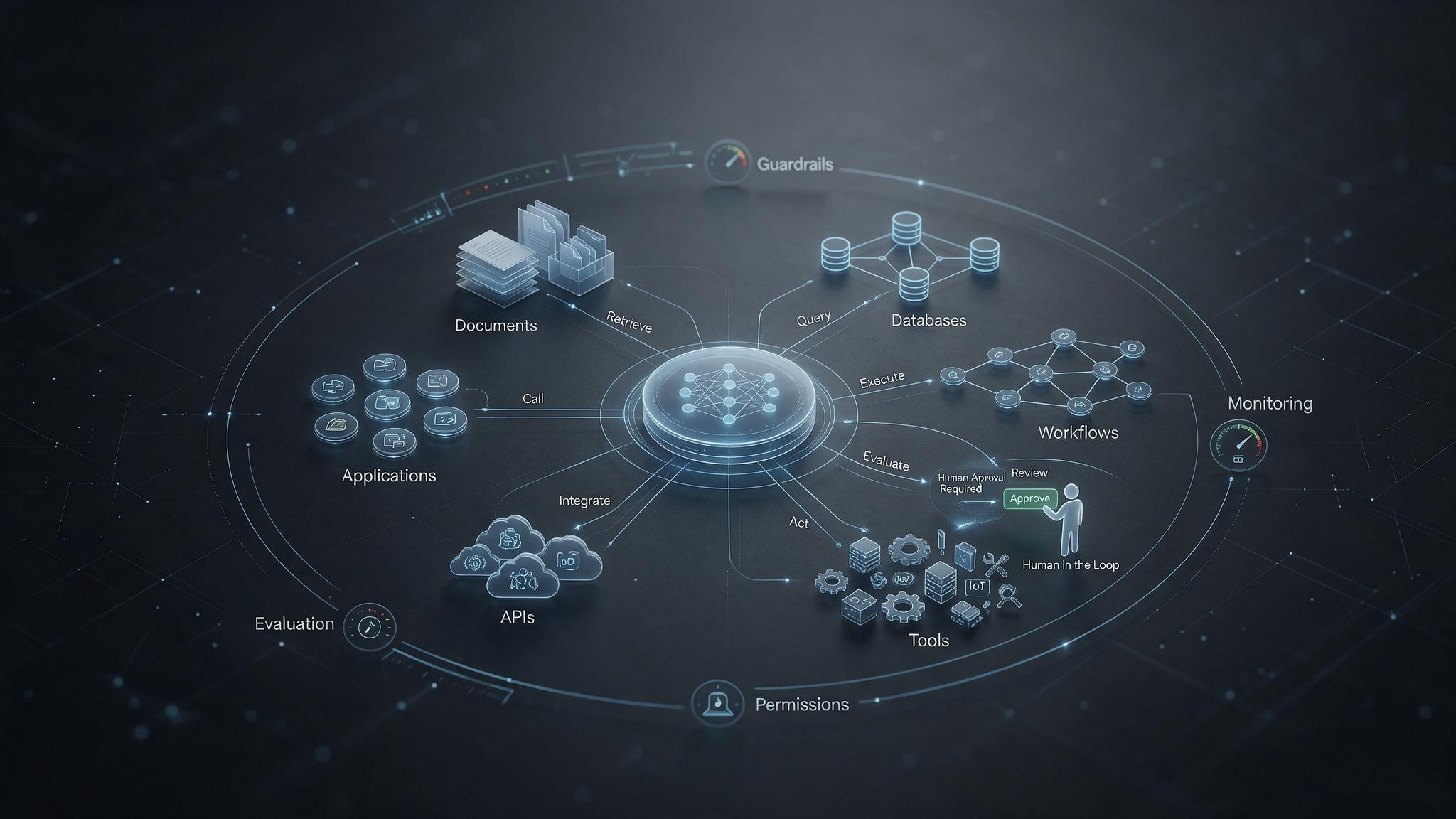
AUTONOMY WHERE IT IS SAFE. APPROVAL WHERE IT IS NOT.
03 — What we build
Six pieces of an agentic system.
Typical agent tasks
Triage and route an incoming request
Assemble a case file from several systems
Reconcile records that disagree
Draft a document from approved sources
Research a supplier, customer or asset
Complete a form or raise a ticket
Under the hood
Agent design
The task boundary, the tools, the memory, the stopping conditions and the escalation rules — written down before any prompt is.
Multi-agent orchestration
Specialised agents coordinated by a supervisor, so a long task decomposes into steps that can each be evaluated, retried and audited on their own.
Tool and system integration
Typed, permissioned access to your ERP, CRM, ticketing, document stores and internal APIs, with the agent carrying the requesting user's entitlements.
Intelligent process automation
Deterministic automation where the rules are clear, agents where judgement or unstructured input is involved, and a clean seam between the two.
Guardrails and human-in-the-loop
Input and output filtering, action-level approval gates, spend and blast radius limits, and a reviewer queue that fits how the team already works.
Evaluation and observability
Task-level test suites, regression runs on every change, and traces that show exactly which step produced which action.
04 — What we insist on
Six rules every agent we run has to meet.
None of these are optional. An agent that cannot meet them does not go into production.
01
A named owner
Every agent in production has a business owner who can switch it off.
02
A bounded task
Agents get one job with a defined stopping condition, never open-ended authority.
03
Least privilege
The agent holds the entitlements of the person it acts for — never more.
04
Reversible actions
Anything an agent changes can be traced, reviewed and undone.
05
Evaluated before release
A regression suite runs on every prompt, model or tool change.
06
Visible in operation
Every run is traceable end to end, and failures surface to a person.
05 — How we get there
Autonomy earned, not assumed.
Agents start under review on every action. The gates open only where the evaluation evidence supports it.
Define
Task boundary, tools, approval rules and the measures of success.
Prototype
A working agent against real data in a controlled environment.
Harden
Guardrails, entitlements, evaluation suite, logging and audit.
Pilot
A real queue with a human reviewing every action the agent proposes.
Operate
Autonomy widened step by step, each step backed by evaluation results.
06 — Where agents sit
Between your people and your systems.
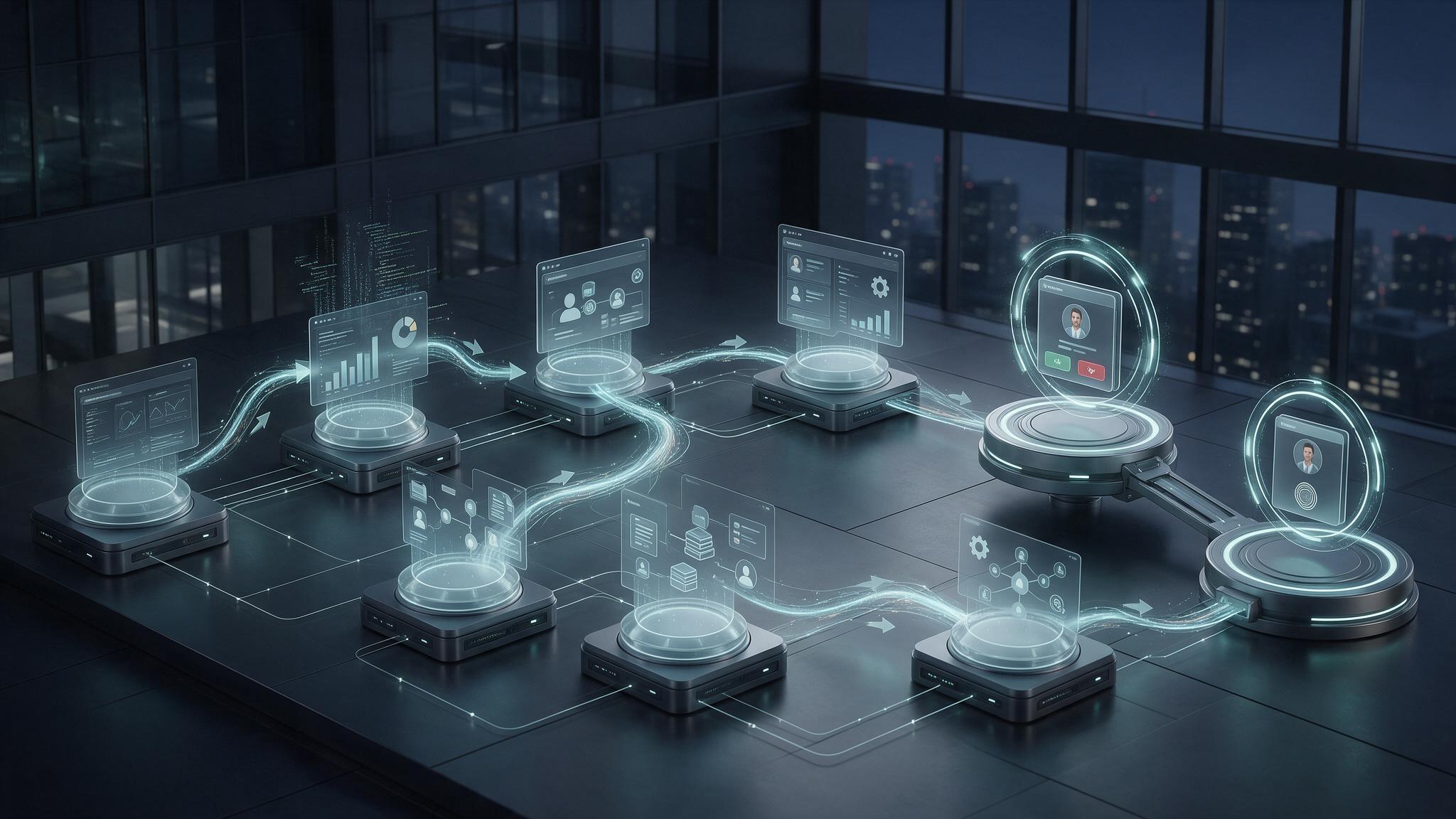
GOVERNED ORCHESTRATION, NOT LOOSE SCRIPTS.
07 — Sound familiar?
The work that agents are actually good at.
“This task crosses four systems and still runs on email.”
Agentic automation
“Our automation breaks whenever a screen changes.”
Agent-based automation
“We want agents, but they must not act on their own.”
Human-in-the-loop design
“How would we even know if an agent got it wrong?”
Evaluation & tracing
“The work needs judgement, so we assumed it could not be automated.”
Agent design
“Our team spends every morning assembling the same case file.”
Multi-agent workflow
08 — The rest of the practice
Six more ways we work on AI.
These services are rarely bought one at a time. Most programmes start with one and pull in the others as the work matures.
Advise
AI Strategy & Advisory
Work out which AI opportunities are real, what they are worth and the order to do them in — before anyone builds anything.
Explore
Transform
AI Transformation Services
Rebuild an end-to-end process around AI — the workflow, the systems, the roles and the measures — so the gain is structural.
Explore
Ground
Generative AI Solutions
Copilots, assistants and knowledge systems grounded in the material you approve — with citations, permissions and review.
Explore
Build
Enterprise AI Engineering
Custom AI applications, enterprise integration and deployment into the environment your security team already accepts.
Explore
Govern
AI Governance & Responsible AI
The framework, guardrails, evaluation and audit trail that let a risk committee approve an AI system.
Explore
Operate
AI Managed Services
We run what we built — and what others built — with monitoring, evaluation, upkeep, cost management and real support.
Explore
Have a problem worth solving?
Bring us the task nobody wants to do.
If it crosses systems, follows rules with exceptions and eats a morning a week, it is usually a good first agent. We will scope it and prove it.