

AI & intelligent services
The controls that let you say yes to AI.
Governance frameworks, runtime guardrails, evaluation and audit built so that AI can be approved, deployed and defended — to your risk committee, your regulator and your customers.
Governance frameworks · Guardrails · Explainability · Compliance · Assurance
01 — Governance is an enabler
The point of governance is not to slow AI down.
It is to make approval possible.
Most AI initiatives that stop, stop at a risk gate — because nobody could describe what the system does, what data it touches, what it may decide alone, or how anyone would know if it went wrong.
Answer those questions once, as a framework, and the second system is approved in a fraction of the time the first one took. That is the return on governance work, and it compounds with every system after it.
So we build the framework and the mechanics together: policy, classification and approval gates on one side; guardrails, evaluation, logging and monitoring on the other. Paper controls nobody enforces are not controls.
Talk to Zealogics02 — The control set
Policy, gates, guardrails, evidence.
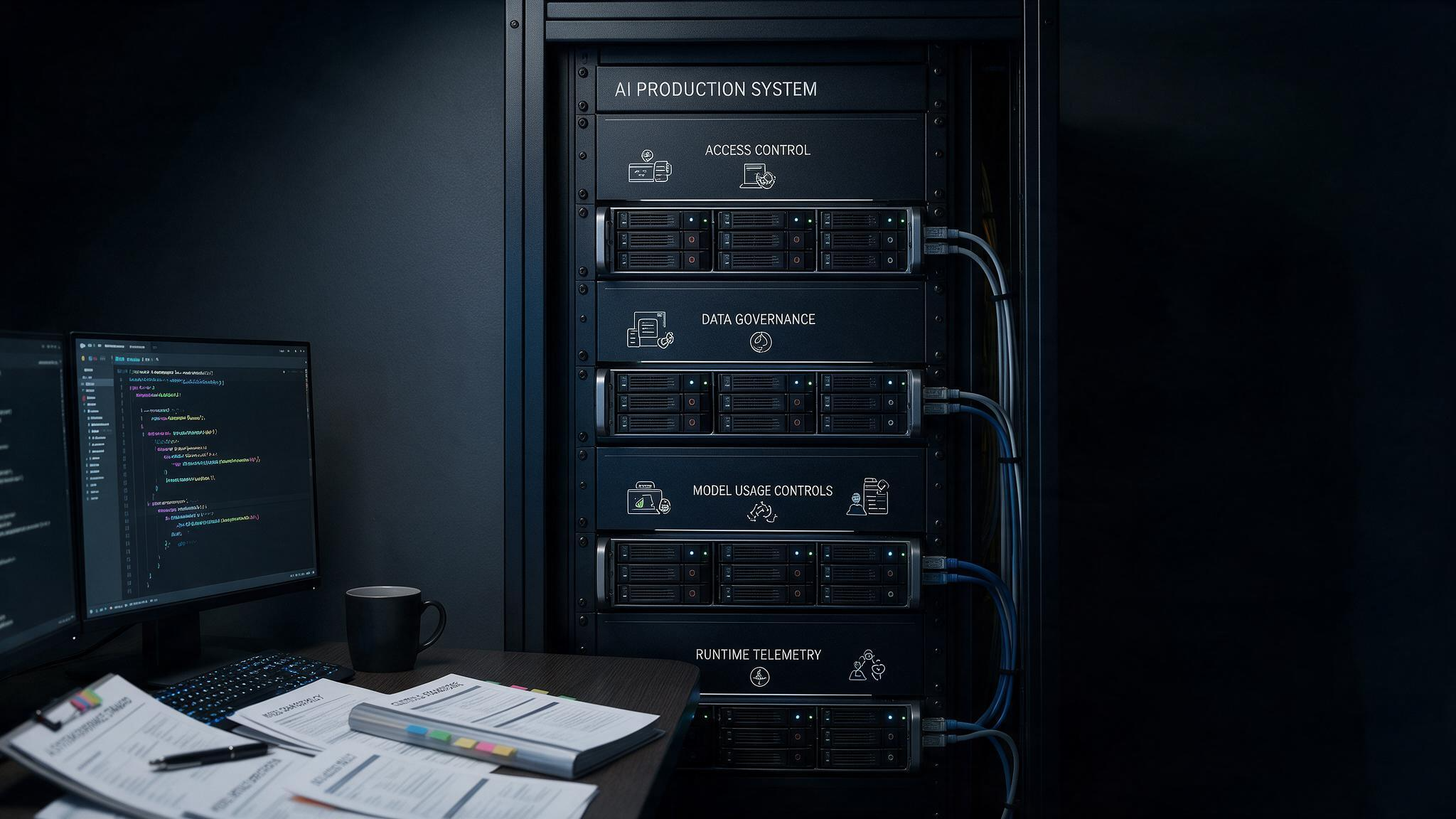
WRITTEN DOWN. ENFORCED IN CODE.
03 — What the work covers
Six layers, from policy to proof.
Questions the framework answers
Which AI systems do we run, and who owns each?
What data may each of them see?
What may a system decide without a human?
How do we know it still works?
What do we tell users and customers?
What happens when it gets something wrong?
Where it applies
AI governance framework
Policy, roles, an AI inventory, risk classification and the approval gates each class has to pass before it goes anywhere near a user.
Risk and compliance alignment
Mapping to the obligations you actually carry — sector regulation, data protection, internal audit standards and emerging AI regulation — with the evidence each of them requires.
Runtime guardrails
Input and output controls, prompt-injection defence, personal data handling, action limits and refusal behaviour, implemented in the system rather than in a document.
Explainability and transparency
What the system used, why it produced what it did, where it was uncertain, and what the user is told — including when they are talking to AI.
Evaluation and assurance
Test suites for correctness, grounding, bias and safety; regression on every change; and periodic independent review.
Monitoring, logging and audit
Complete traces of decisions and actions, retention aligned to your policy, and reporting your audit function can use without a translator.
04 — What good looks like
Six marks of governance that is actually working.
Every one of these is observable. If you cannot check it, it is a statement of intent rather than a control.
01
An inventory
Every AI system recorded with its owner, purpose, data and risk class.
02
Proportionate gates
A low-risk assistant does not carry the approval process of a decisioning system.
03
Enforced guardrails
Controls live in the runtime, with tests that prove they still hold.
04
Human authority
Where a person must decide, the system cannot proceed without them.
05
Evidence by default
Logging produces the audit trail as a by-product of running, not as an exercise before an audit.
06
Periodic review
Systems are re-evaluated on a schedule, and drift is caught before users report it.
05 — How the work runs
Framework first, then enforcement.
Governance written without the engineers who have to implement it becomes shelfware. Both sides are in the room throughout.
Assess
Current AI inventory, the obligations you carry, and the gaps between them.
Frame
Policy, risk classification, approval gates and roles, agreed with risk and legal.
Implement
Guardrails, evaluation and logging built into the systems themselves.
Assure
Independent review and an evidence pack that survives scrutiny.
Sustain
Monitoring, periodic re-evaluation and upkeep of the framework itself.
06 — Across the lifecycle
Controls at every stage, not a gate at the end.
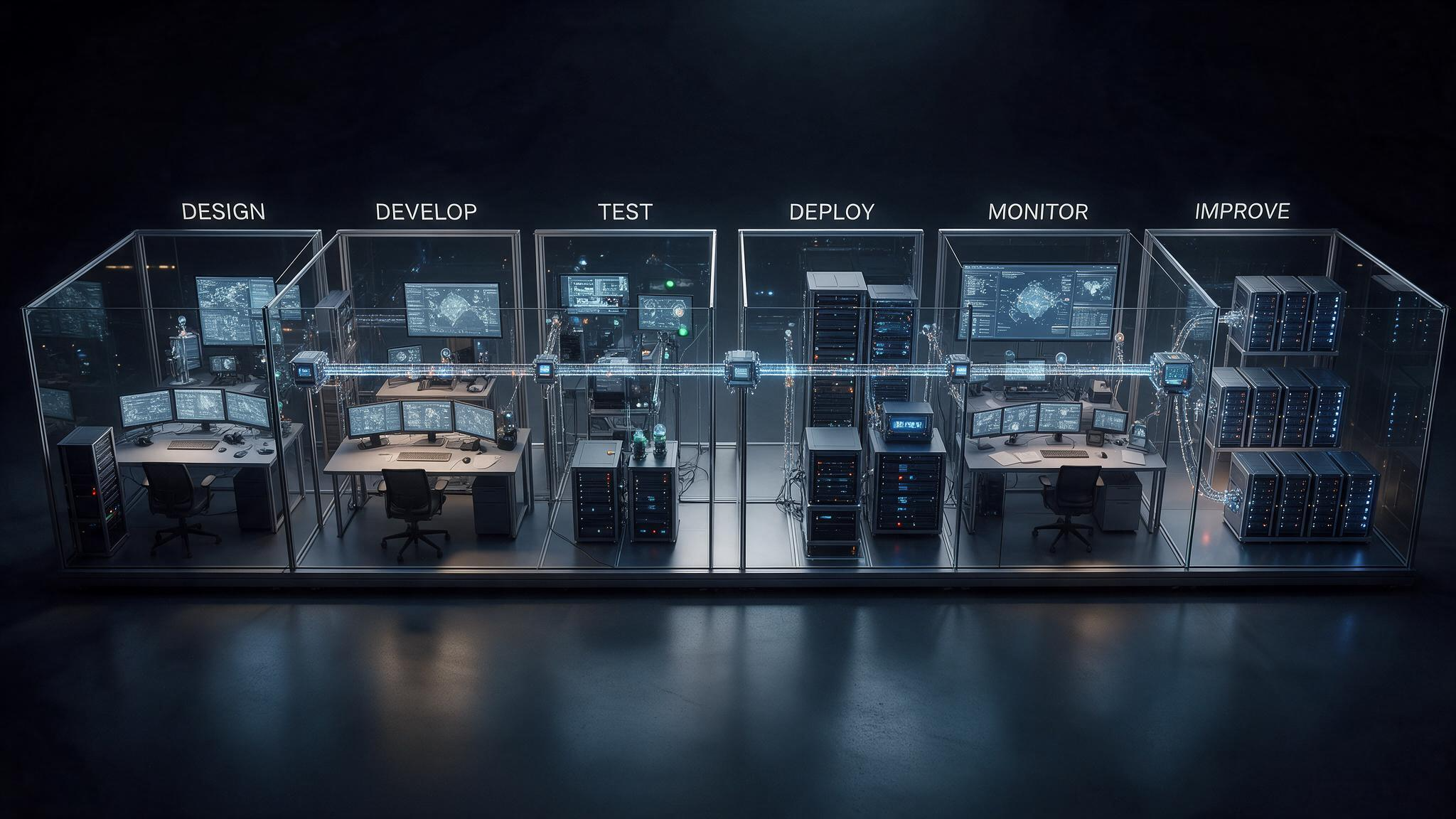
APPROVE ONCE. REUSE THE PATTERN.
07 — Sound familiar?
What stops AI systems at the last gate.
“Our risk committee will not approve an AI system.”
Governance framework
“We cannot explain how it reached that answer.”
Explainability
“We do not know what AI is already running here.”
AI inventory
“How do we show it is not biased?”
Evaluation & assurance
“What happens if somebody jailbreaks it?”
Runtime guardrails
“Our auditors want evidence, not assurances.”
Logging & audit
08 — The rest of the practice
Six more ways we work on AI.
These services are rarely bought one at a time. Most programmes start with one and pull in the others as the work matures.
Advise
AI Strategy & Advisory
Work out which AI opportunities are real, what they are worth and the order to do them in — before anyone builds anything.
Explore
Transform
AI Transformation Services
Rebuild an end-to-end process around AI — the workflow, the systems, the roles and the measures — so the gain is structural.
Explore
Automate
Agentic AI & Automation
Agents that carry multi-step work across your systems under guardrails, evaluation and human approval.
Explore
Ground
Generative AI Solutions
Copilots, assistants and knowledge systems grounded in the material you approve — with citations, permissions and review.
Explore
Build
Enterprise AI Engineering
Custom AI applications, enterprise integration and deployment into the environment your security team already accepts.
Explore
Operate
AI Managed Services
We run what we built — and what others built — with monitoring, evaluation, upkeep, cost management and real support.
Explore
Have a problem worth solving?
Get the first approval right and the rest follow.
Whether you are building the framework or trying to get one system through a gate, we will work out what is missing and what it takes to close it.