
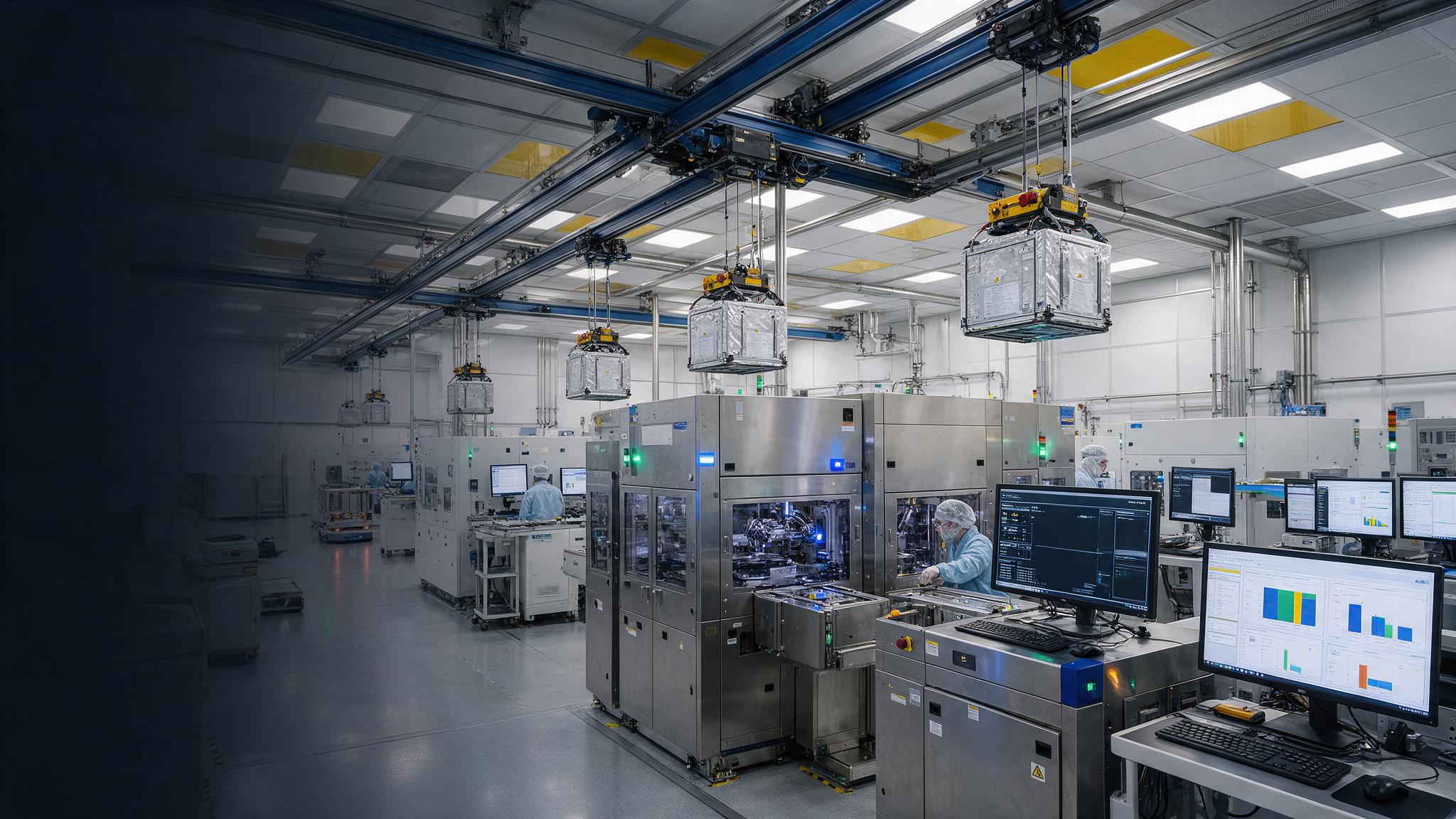
Engineering services
Connect the equipment. Then make the factory intelligent.
We engineer the automation layer between semiconductor equipment and the factory — control software, communication standards, EAP and MES integration, and the manufacturing data everything above it depends on.
Equipment software · SECS/GEM · GEM300 · EAP / MES · Manufacturing data · FDC
01 — Where factory automation gets hard
The standards are published. The integration still takes years.
Because no two tools implement them the same way.
A fab runs equipment from a dozen vendors, across generations, with interfaces ranging from a clean GEM300 implementation to a proprietary socket and a spreadsheet of message codes. Connecting them is rarely a protocol problem — it is an archaeology problem.
We work outward from the equipment: controller and equipment software first, then the communication layer, then the path into EAP, MES, scheduling, dispatch and material handling — validating every interface against a host simulator before it ever meets a production tool.
The data foundation comes with it. Equipment and process data that is collected, normalised and given context is what makes fault detection, predictive maintenance and yield analytics possible. Without it, an intelligence layer is a demonstration.
Talk to Zealogics02 — The layer we engineer
Everything between the tool and the factory system.
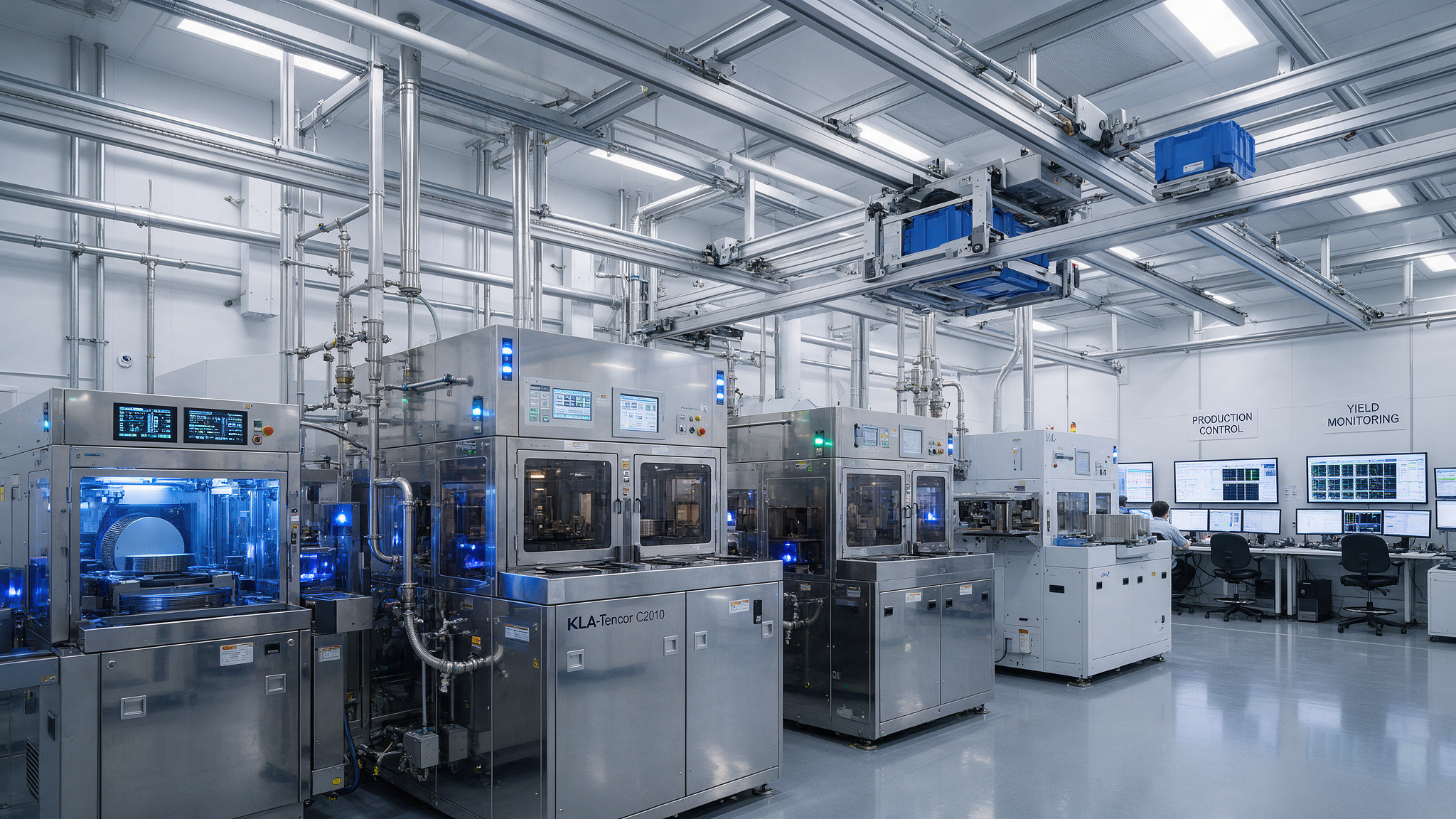
EQUIPMENT · INTERFACE · FACTORY SYSTEM · DATA.
03 — What the work covers
Five bodies of work, scoped to the factory in front of us.
Equipment we work across
Process equipment — deposition, etch, litho, clean
Metrology, inspection and alignment systems
Semiconductor test and automated test environments
Advanced packaging, assembly and handling
Wafer and material movement systems
Legacy tools on proprietary interfaces
Interfaces and factory systems
Equipment software and control systems
Cluster tool controllers, process module controllers, equipment control software, recipe management, alarm and event handling, wafer handling automation, scheduling and process sequencing, equipment state management and closed-loop process control.
Equipment integration and factory communication
SECS/GEM and GEM300 host communication, EDA / Interface A, OPC-UA, OEM and proprietary interfaces, factory host and MES integration, equipment onboarding, qualification and factory orchestration.
Manufacturing data engineering
Equipment data collection, manufacturing data pipelines, normalisation and contextualisation, equipment performance and throughput monitoring, process and yield analytics, and dashboards the floor will actually read.
Intelligent manufacturing
Fault detection and classification, predictive maintenance, equipment health monitoring, process drift and anomaly detection, root cause analysis and process optimisation analytics — an intelligence layer built on integration and data, not a standalone product.
Simulation, validation and digital twins
Equipment and factory simulation, host and MES simulators, digital twin development, FAT automation, integration testing and production readiness validation before a tool ever sees a wafer.
04 — Two starting points
Modernise what exists. Engineer what comes next.
Greenfield and brownfield need different first moves — and most manufacturers are running both at the same time.
01
Factory automation architecture
For a new line: the equipment integration, host and data architecture defined before the first tool is ordered.
02
Equipment onboarding strategy
How tools arrive, get qualified and reach production — a repeatable process rather than a per-vendor negotiation each time.
03
Legacy equipment integration
Older tools brought onto current interfaces without replacing infrastructure that is still doing its job.
04
Interface modernisation
Proprietary and first-generation interfaces brought up to SECS/GEM, GEM300 or EDA wherever the tool allows it.
05
Manufacturing data modernisation
A data foundation retrofitted to a running factory — collection, normalisation and context, without a production stop.
06
FDC and analytics enablement
Fault detection, drift monitoring and analytics stood up on data that is already trustworthy enough to act on.
05 — How engagements run
From engineering requirement to production.
The same five stages whether the work is one stubborn interface or a whole automation architecture — only the duration changes.
Assess
Understand the equipment, factory systems, interfaces, constraints and objectives as they actually are.
Architect
Define the equipment, software, communication, automation and data architecture, and the interfaces between them.
Engineer
Develop equipment software, integration components, factory applications and data solutions.
Validate
Simulation, FAT, automated testing, qualification and end-to-end integration validation.
Deploy & optimise
Production deployment, equipment onboarding and factory ramp — then reliability, visibility and automation coverage.
06 — Six disciplines, one programme
Factory automation needs more than automation software.
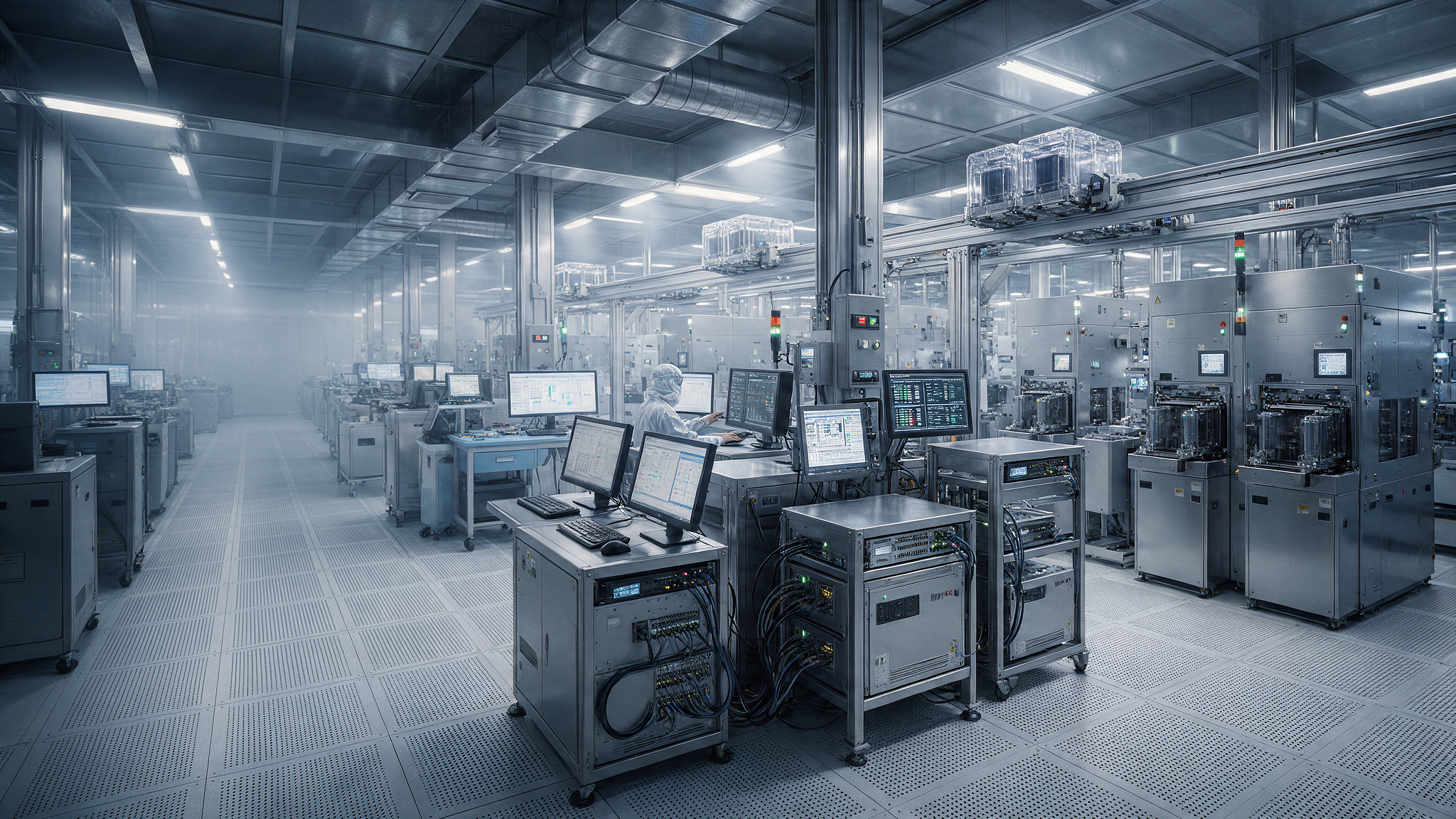
EMBEDDED · SOFTWARE · SYSTEMS · MANUFACTURING · DATA · AI.
07 — Sound familiar?
The conversations that start this work.
“We have twelve tool vendors and twelve integration approaches.”
Equipment integration
“The new tool is on the floor and not talking to the host.”
Onboarding and qualification
“Our FDC is only as good as the data going into it.”
Manufacturing data engineering
“These tools predate GEM300 and we are not replacing them.”
Brownfield modernisation
“We find interface problems during ramp, not before it.”
Simulation and FAT automation
“We are building a new fab and the automation architecture is blank.”
Greenfield architecture
08 — The rest of the practice
Five more engineering disciplines.
Programmes rarely stay inside one discipline. A tool that needs embedded firmware usually needs the mechanics, the harness and the line that builds it too.
Embed
Embedded Systems
Turn a product concept into hardware and the firmware that runs it — schematics, layout, bring-up, certification and the years of sustenance after.
Explore
Design
Silicon Engineering
Full-chip design across ASICs, SoCs, FPGAs and chiplets — architecture, RTL, verification, DFT, analog and physical design through tape-out and post-silicon validation.
Explore
Design
Mechanical Engineering
Product design and development, engineering analysis and simulation, model-based systems engineering, and the change management that keeps a design alive for a decade.
Explore
Route
Electrical Engineering
Wiring harness design, 3D routing, schematics, bundling and segregation, power distribution and the build support that gets a harness onto the shop floor.
Explore
Build
Manufacturing
PCB, turnkey, box build, harness and cleanroom assembly under the same engineering ownership as the design — with the test capability to prove what shipped.
Explore
Have a problem worth solving?
Start with the tool that will not integrate.
Bring us one stubborn interface, a stalled onboarding or a blank greenfield architecture. The first assessment is short, and it usually settles the approach for everything after it.