
AI & intelligent services
AI does not stay working on its own.
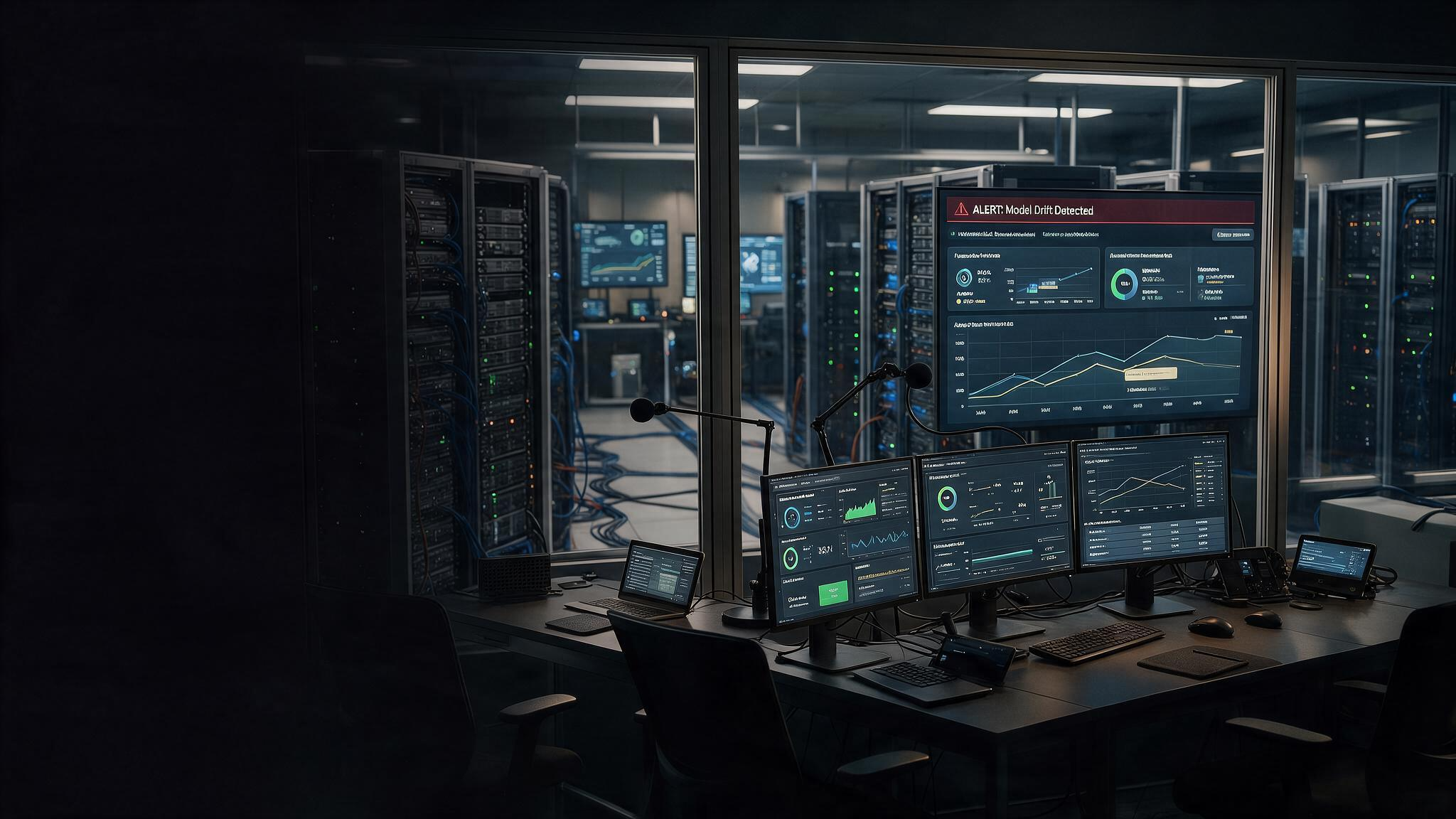
We run what we build — and what others built — with monitoring, continuous evaluation, model and prompt upkeep, cost management and a support model your users can actually reach.
Monitoring · Evaluation · Optimisation · Support · Continuous improvement
01 — Why AI degrades
Nothing broke.
The world moved.
Your documents change. Your processes change. Providers deprecate models and quietly adjust behaviour on the ones they keep. Usage shifts as people learn what the system can do. None of that is a fault, and all of it degrades quality.
Without continuous evaluation the degradation stays invisible until users stop trusting the system — at which point recovering their confidence costs considerably more than the upkeep would have.
A managed service replaces that with a running measurement, a known baseline, a named owner and a change process — for systems we built and for systems we inherit.
Talk to Zealogics02 — What we watch
Quality, cost, usage and failure — continuously.

IF IT IS NOT MEASURED, IT IS NOT RUNNING.
03 — What the service covers
Six responsibilities we take on.
Covered in a typical service
Agents and orchestration workflows
Retrieval and knowledge indexes
Custom AI applications
Vision and forecasting models
Integrations and connectors
Infrastructure and deployment pipelines
Reported every month
Monitoring and observability
Quality, latency, cost, usage and error rates tracked per system, alerting on the thresholds you set rather than on defaults.
Continuous evaluation
Your regression suite re-run on a schedule and on every change — model, prompt, content or dependency — with results published against the baseline.
Model and prompt lifecycle
Provider deprecations handled ahead of the deadline, candidate models evaluated against your own tests, and changes promoted through environments.
Content and retrieval upkeep
Re-indexing, source additions and removals, permission changes, and the retrieval-quality checks that keep grounded answers grounded.
Cost optimisation
Routing, caching, context discipline and model right-sizing, reported per system and per business owner.
Support and incident response
A named team, agreed response targets, a clear escalation path and post-incident review.
04 — How the service runs
Six things the engagement is built on.
A managed service that cannot show its own performance is asking for the same trust it was hired to establish.
01
A baseline
We establish the current quality and cost position before taking anything on.
02
A named team
The same engineers, familiar with your systems — not a rotating queue.
03
Agreed targets
Response and resolution commitments written into the service, not implied.
04
A change process
Nothing reaches production without passing your evaluation gate.
05
Monthly reporting
Quality, cost, usage, incidents and what we propose to improve next.
06
A transfer path
Everything documented, so you can take it back in-house whenever you choose.
05 — How we take it on
Assess before we promise.
We do not quote a service on a system we have not inspected. The assessment is short and it is the honest basis for everything after.
Assess
Inventory, baseline, risks and the gaps in what exists today.
Onboard
Monitoring, evaluation suites, runbooks and access in place.
Stabilise
Clear the known issues and establish the reporting rhythm.
Operate
Monitoring, upkeep, support and controlled change.
Improve
A standing backlog of quality and cost improvements, agreed each month.
06 — The operating rhythm
Measure, report, improve, repeat.

RUN IT LIKE A SERVICE.
07 — Sound familiar?
What brings systems into a managed service.
“It was good at launch and people quietly stopped using it.”
Continuous evaluation
“Our provider is deprecating the model we built on.”
Model lifecycle
“Our AI spend went up and nobody can explain why.”
Cost optimisation
“The team that built it has moved on.”
Managed operations
“Nobody is checking whether the answers are still right.”
Quality monitoring
“When it breaks, no one knows who to call.”
Support & incident response
08 — The rest of the practice
Six more ways we work on AI.
These services are rarely bought one at a time. Most programmes start with one and pull in the others as the work matures.
Advise
AI Strategy & Advisory
Work out which AI opportunities are real, what they are worth and the order to do them in — before anyone builds anything.
Explore
Transform
AI Transformation Services
Rebuild an end-to-end process around AI — the workflow, the systems, the roles and the measures — so the gain is structural.
Explore
Automate
Agentic AI & Automation
Agents that carry multi-step work across your systems under guardrails, evaluation and human approval.
Explore
Ground
Generative AI Solutions
Copilots, assistants and knowledge systems grounded in the material you approve — with citations, permissions and review.
Explore
Build
Enterprise AI Engineering
Custom AI applications, enterprise integration and deployment into the environment your security team already accepts.
Explore
Govern
AI Governance & Responsible AI
The framework, guardrails, evaluation and audit trail that let a risk committee approve an AI system.
Explore
Have a problem worth solving?
Hand it over, or hand it back better.
Whether we built it or you did, we will assess what is running, tell you where it stands, and take it on from there.