
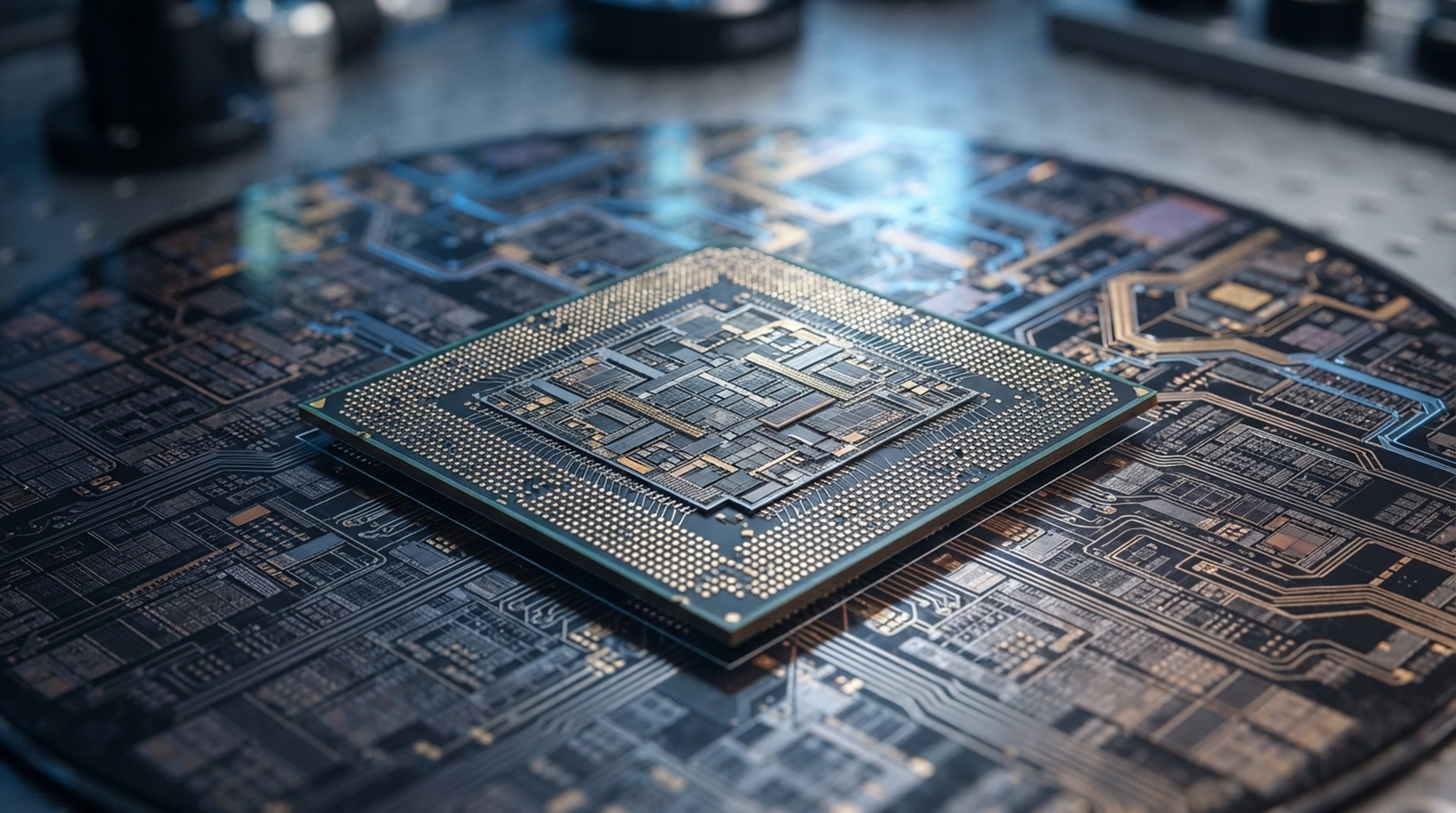
Engineering services
Hardware and firmware, owned from concept to sustenance.
We take embedded products from feasibility through schematics, layout, bring-up and certification — then keep them shipping through component obsolescence, cost-downs and years of field revisions.
Board design · Firmware · Bring-up · DVT · Certification · Sustenance
01 — Why embedded programmes slip
The schematic is rarely what delays the product.
Bring-up, compliance and obsolescence are.
A board that simulates cleanly still has to come up on a bench, pass EMC, survive a thermal chamber and be buildable by a contract manufacturer who has never seen it. Each of those is a different skill, and programmes stall when each is handed to a different supplier.
We keep hardware and firmware under one owner. The people who drew the schematic write the bring-up scripts, sit with the board through design verification and prepare the pack the certification lab needs — so a failure found on the bench goes straight back to the person who can fix it.
The same team stays with the product afterwards. Sustenance engineering — obsolescence, cost reduction, field revisions, respins — is where most of a product's life is spent, and where most of its margin is quietly lost.
Talk to Zealogics02 — What you get back
A board that comes up, and the evidence that it works.
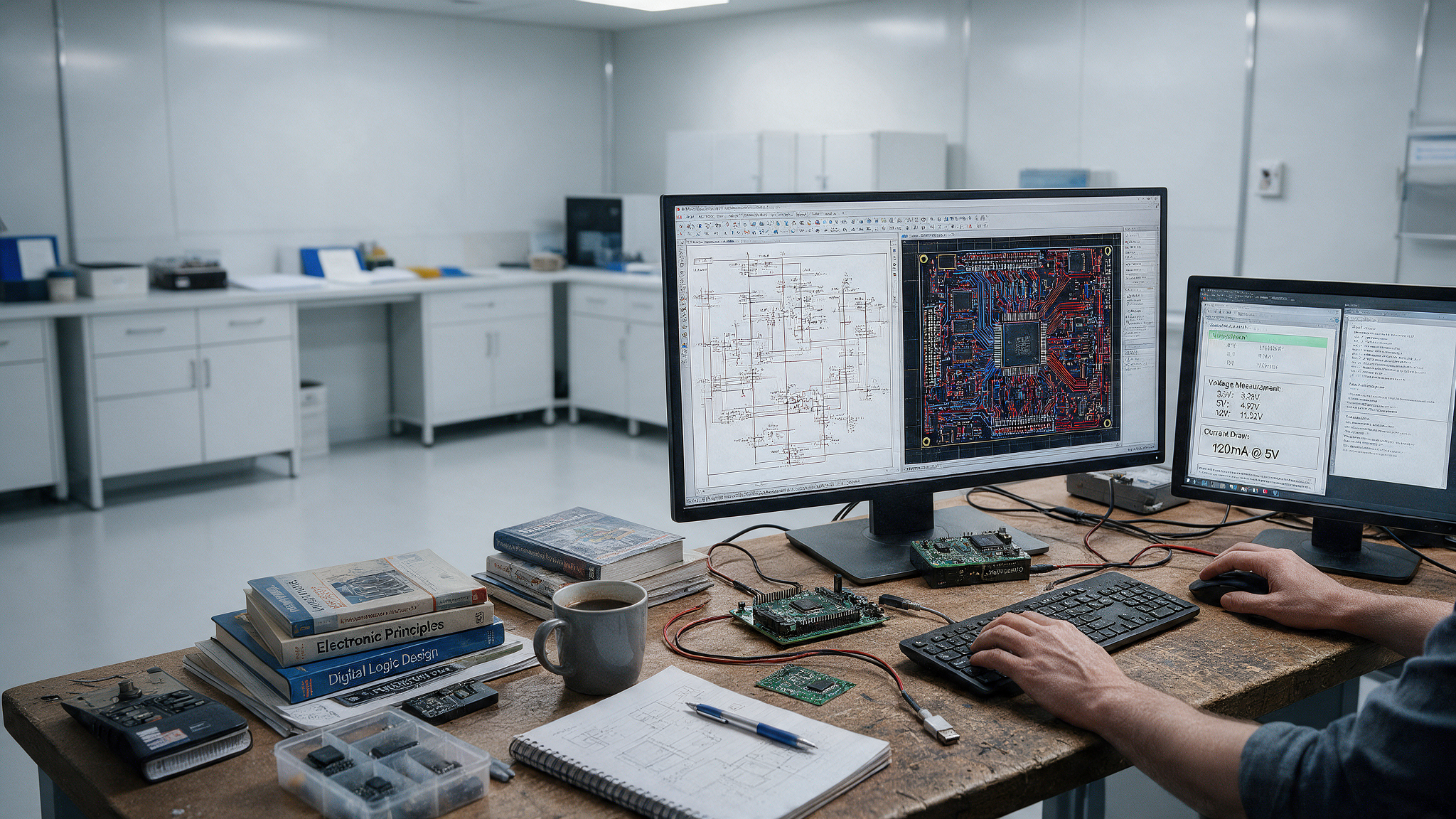
SCHEMATIC, LAYOUT, BRING-UP LOG, TEST REPORT, BUILD PACK.
03 — What the work covers
Two disciplines, run as one team.
Where these boards run
Semiconductor equipment control, laser and metrology
Avionics, flight control, navigation and comms
Automotive infotainment, ADAS, telematics and EV
Medical devices and remote patient monitoring
Telecom network equipment, routers and VoIP
Smart grid, energy management and IoT utilities
Methods and analysis
Feasibility and architecture
Requirements, block diagram, processor and component selection, power budget and a risk list before anything is drawn — including what has to be prototyped early because the datasheet will not settle it.
Schematics and PCB layout
Multi-layer schematic capture and layout with signal and power integrity simulation, controlled impedance, thermal simulation, and a Gerber pack a fabricator can build without a phone call.
Design for manufacture and reliability
DFM and DFT review, FMEA and MTBF analysis, and a BOM worked for cost, lead time and second sources rather than inherited from a reference design.
Firmware and board support
Boot loaders, device drivers, board support packages, OS porting and migration, protocol stack integration, feature enhancement and the HMI layer that sits on top.
Connectivity and cloud integration
Wireless protocol integration and cloud connectors — Azure IoT Edge, AWS Greengrass, PTC ThingWorx — over MQTT, HTTPS, CoAP and AMQP, with the security model decided rather than inherited.
Bring-up, validation and certification
Board bring-up, functional test, design verification testing, environmental compliance and the regulatory certification pack — plus production test automation and manufacturing test software for the line.
04 — What ships with the design
Six things a supplier should hand over, and usually does not.
A schematic on its own is not a product. These are what turn a working prototype into something a factory can build and a team can maintain.
01
Buildable manufacturing pack
Gerbers, assembly drawings, pick-and-place data and a sourced BOM with qualified alternates — loadable by the contract manufacturer without a redraw.
02
Bring-up evidence
Rail-by-rail power-up log, clock and reset verification, and the bench results behind every claim that a subsystem works.
03
Design verification report
DVT run against the requirement list, recording the failures, the fixes and the retests — not only the passes.
04
Certification pack
Test plans, pre-compliance results and the documentation the regulatory lab needs, prepared before the booking rather than after the first failure.
05
Production test software
Functional test fixtures and automation so the line can screen boards without an engineer standing beside them.
06
Obsolescence plan
Which parts go end-of-life first, what the qualified alternates are, and what a respin would cost if one is ever forced.
05 — How a build runs
Five gates, each ending in something you can hold.
Every gate closes on an artefact — a document, a board or a test report — so progress is visible without having to ask for it.
Define
Requirements, architecture, component selection and the feasibility questions that need a prototype to answer.
Design
Schematic capture, layout, signal, power and thermal simulation, DFM review and BOM optimisation.
Build
Fabrication, assembly, prototype build and first article inspection.
Bring up
Power-up, firmware integration, functional test and design verification against the requirement list.
Certify & sustain
Environmental and regulatory testing, production test automation, then sustenance for the life of the product.
06 — Across the boundary
One team either side of the hardware / firmware line.
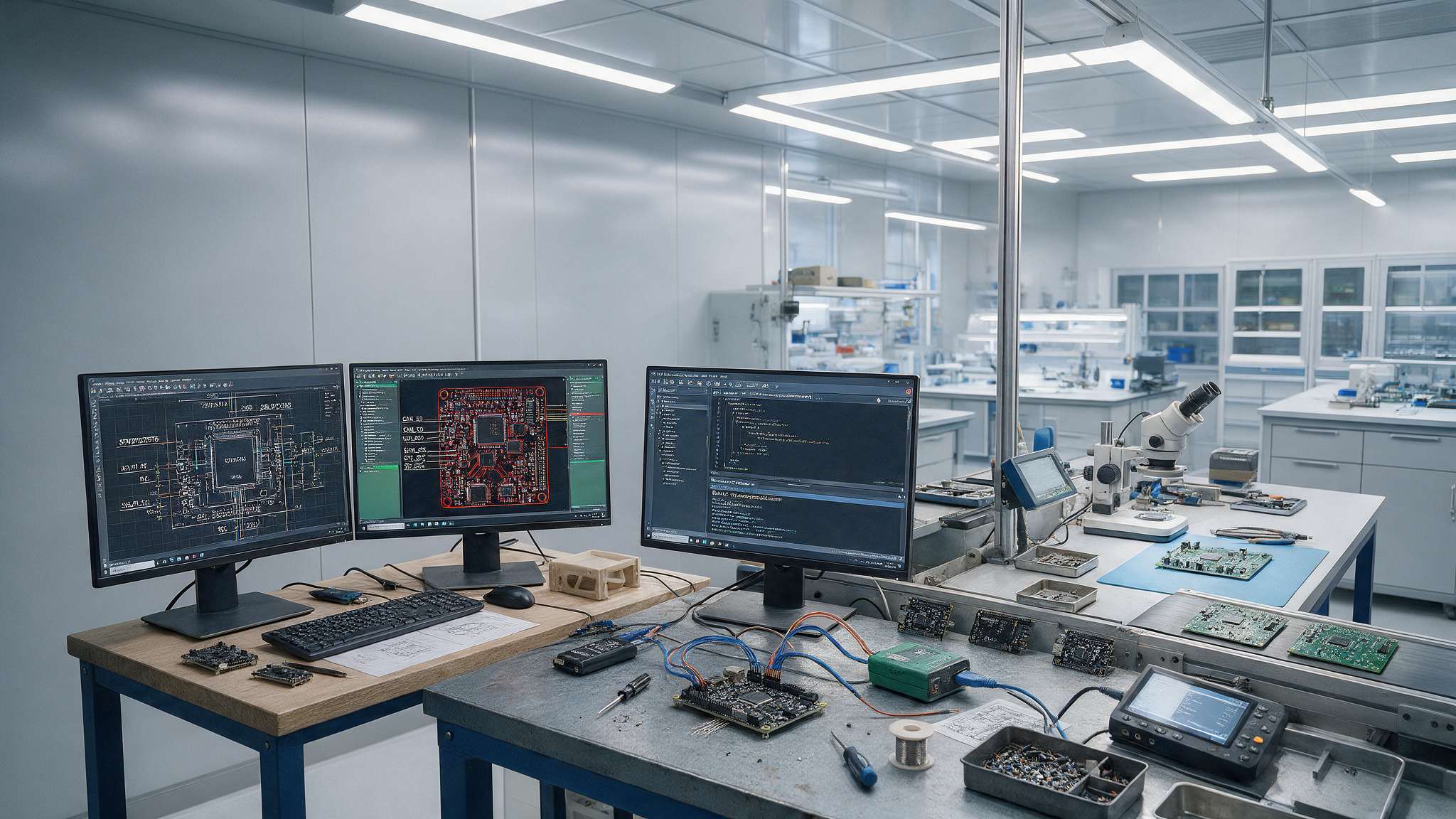
SCHEMATIC TO FIRMWARE TO LINE, WITHOUT A HANDOVER.
07 — Sound familiar?
The conversations that start this work.
“The board works on the bench and fails EMC.”
Pre-compliance and respin
“The part we designed around just went end-of-life.”
Obsolescence management
“Hardware and firmware blame each other for the same bug.”
Single-team bring-up
“The contract manufacturer keeps coming back with questions.”
DFM and build pack
“We have a prototype and no route to volume.”
Production test and NPI
“Nobody has touched this product's firmware in four years.”
Sustenance engineering
08 — The rest of the practice
Five more engineering disciplines.
Programmes rarely stay inside one discipline. A tool that needs embedded firmware usually needs the mechanics, the harness and the line that builds it too.
Connect
Factory Automation
Equipment software, SECS/GEM and GEM300 integration, EAP and MES connectivity, manufacturing data — and the intelligence layer built on top of them.
Explore
Design
Silicon Engineering
Full-chip design across ASICs, SoCs, FPGAs and chiplets — architecture, RTL, verification, DFT, analog and physical design through tape-out and post-silicon validation.
Explore
Design
Mechanical Engineering
Product design and development, engineering analysis and simulation, model-based systems engineering, and the change management that keeps a design alive for a decade.
Explore
Route
Electrical Engineering
Wiring harness design, 3D routing, schematics, bundling and segregation, power distribution and the build support that gets a harness onto the shop floor.
Explore
Build
Manufacturing
PCB, turnkey, box build, harness and cleanroom assembly under the same engineering ownership as the design — with the test capability to prove what shipped.
Explore
Have a problem worth solving?
Bring us the block diagram — or the board that will not come up.
A short review of the schematic, the layout or the bring-up log is usually enough to tell you whether what you are looking at is a design problem, a firmware problem or a manufacturing one.